










GENLaw is pleased to announce that Steve Zhao, Partner, was invited to speak at the 2026 ASEAN Digital Economy & Intellectual Property Summit and the 4th XMUM Intellectual Property & Innovation International Conference, held on 12 May 2026 at Xiamen University Malaysia (XMUM). Mr. Zhao contributed to multiple sessions, sharing insights on cutting-edge issues at the intersection of artificial intelligence and intellectual property law.
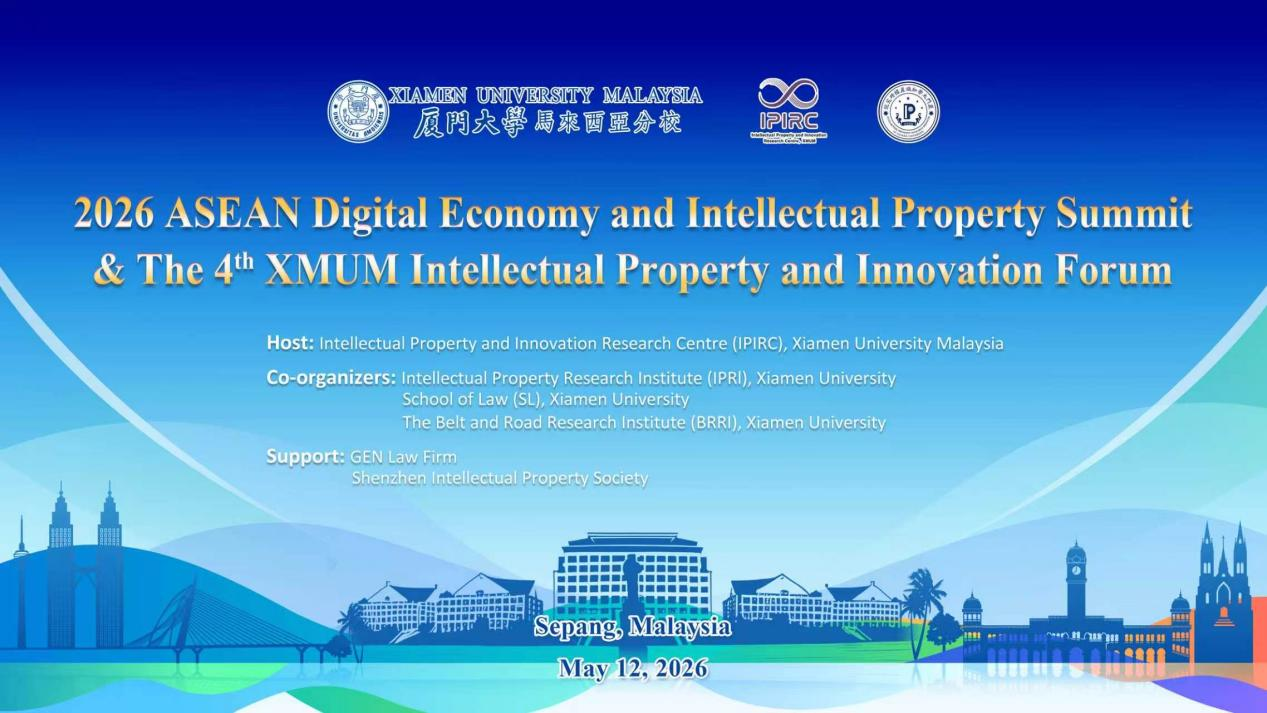
The conference was hosted by the Intellectual Property and Innovation Research Centre (IPIRC) of Xiamen University Malaysia, with co-organization by the Xiamen University IP Research Institute, the Xiamen University School of Law, and the Belt and Road Research Institute (BRRI). GENLaw served as a supporting institution for the event.
More than fifty scholars, legal practitioners, and industry leaders from China, Malaysia, Thailand, Vietnam, and other jurisdictions attended the event, which comprised an opening ceremony, thematic panel sessions, a roundtable discussion, and a closing ceremony. Discussions centered on the overarching theme of "ASEAN Digital Economy and Intellectual Property: Innovation, Collaboration, and Governance," addressing the development of IP frameworks in the digital economy, cross-border regulatory coordination, and emerging digital governance architectures.
Panel II — Potential Solutions to IP Challenges in the AI Era
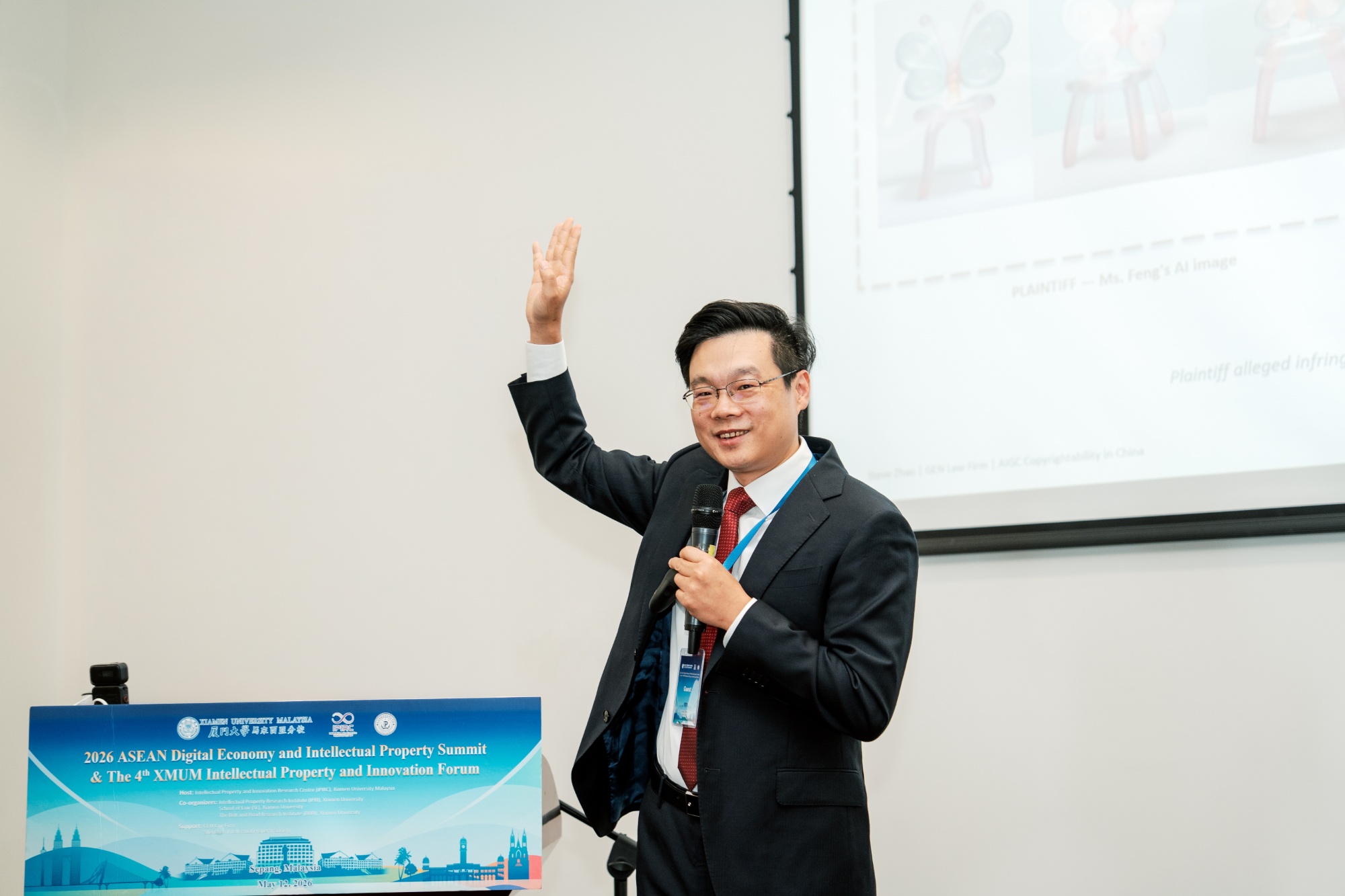
Moderated by Associate Professor Wang Jun of the Xiamen University IP Research Institute, Panel II brought together lawyers and academics from multiple jurisdictions to examine frontier questions in AI and intellectual property.
Mr. Zhao delivered a presentation entitled "Copyrightability of AIGC in China: Understanding Current Judicial Protection of AI-Generated Works Based on Recent Cases," offering a systematic analysis of how Chinese courts have approached the copyrightability of AI-generated content and the core doctrinal tensions that have emerged.
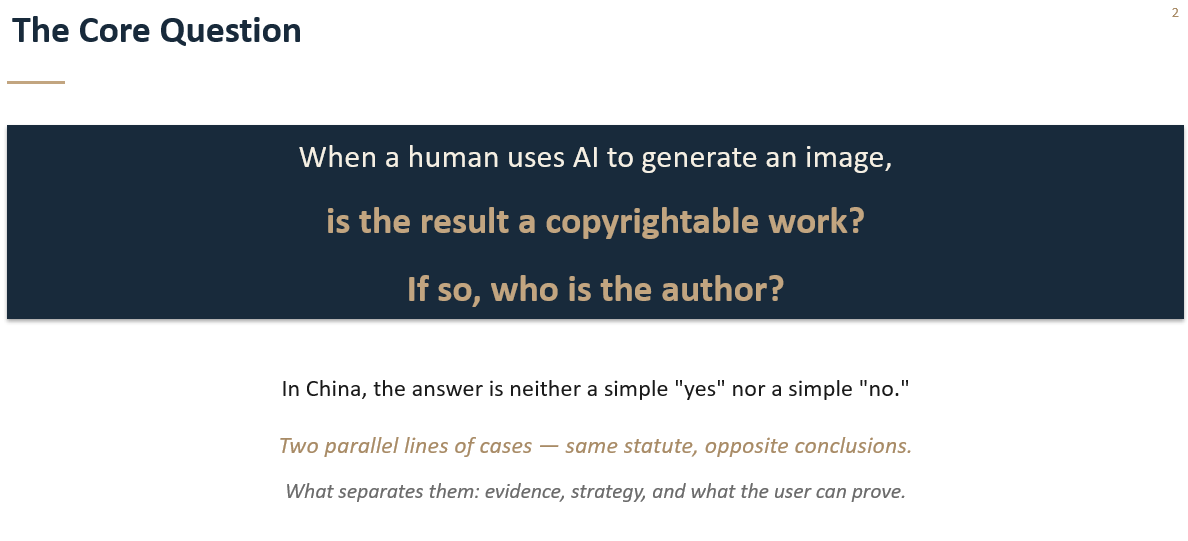
Mr. Zhao observed that Chinese jurisprudence has produced two parallel lines of authority — courts applying the same statute have reached diametrically opposite conclusions. He identified four issues that Chinese courts consistently examine:
• Nature of the Prompt — Does typing keywords constitute 'creation'? Or merely the expression of a hope?
• Degree of User Control — Where on the spectrum from one-click to thousand-iteration refinement does authorship begin?
• Reproducibility & Provenance — Does randomness undermine authorship? Can the user produce contemporaneous creation records?
• Idea vs. Expression — If prompts encode only ideas and AI supplies the expression, who owns the result?
Drawing on landmark decisions including the Spring Breeze case, the Butterfly Chair case, and the Cat Pendant case, Mr. Zhao traced the reasoning of both the affirmative and negative lines of authority.
He provided a detailed account of the Butterfly Chair case (Zhangjiagang People's Court, (2024) Su 0582 Min Chu No. 9015, effective April 2025) — China's first effective judgment holding that an AI text-to-image output does not constitute a copyrightable work — in which he served as counsel for the defendant. Mr. Zhao reconstructed the plaintiff's creation process and explained the four-layer progressive defense architecture he developed for the case:
1. Standing — The plaintiff was not a proper rights-holder.
2. Copyrightability (main battlefield) — The AI output did not constitute a "work" within the meaning of the Copyright Law.
3. Substantial Similarity — The defendant's three-dimensional products differed materially from the plaintiff's two-dimensional images.
4. Scope of Protection — Overlapping elements belonged to the public domain or were autonomously generated by the AI, rather than constituting the plaintiff's original expression.
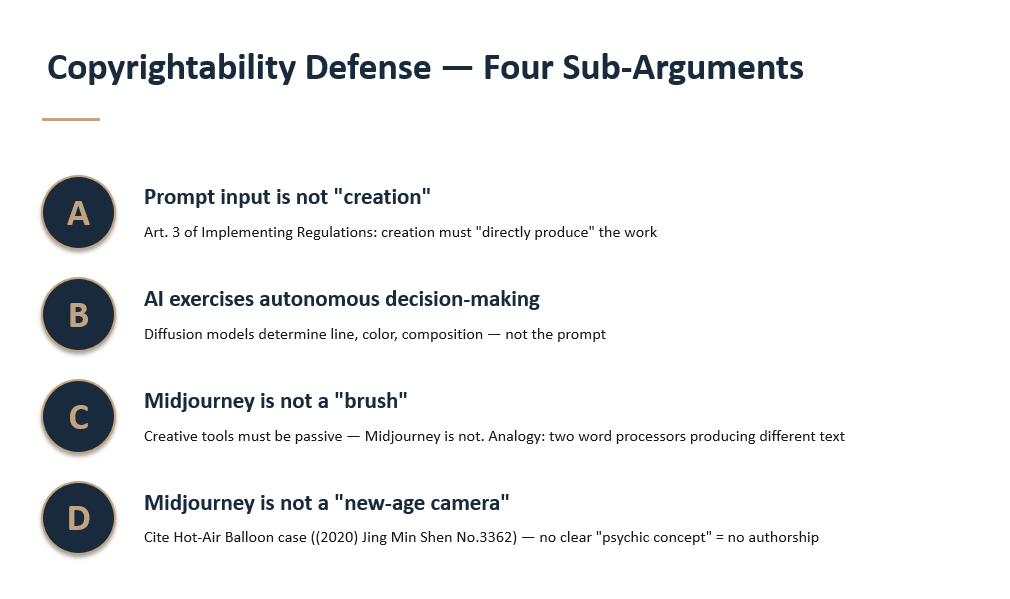
The court adopted the copyrightability defense and grounded its judgment on three standards:
• Creative Dominion — The user must exercise direct control over the final expression and make a substantive creative contribution.
• Dual-Track Test — Simple prompts combined with selection do not produce a copyrightable work; iterative refinement combined with post-output editing may.
• Evidentiary Standard — Original, contemporaneous creation records are required; records generated after the commencement of litigation are insufficient.
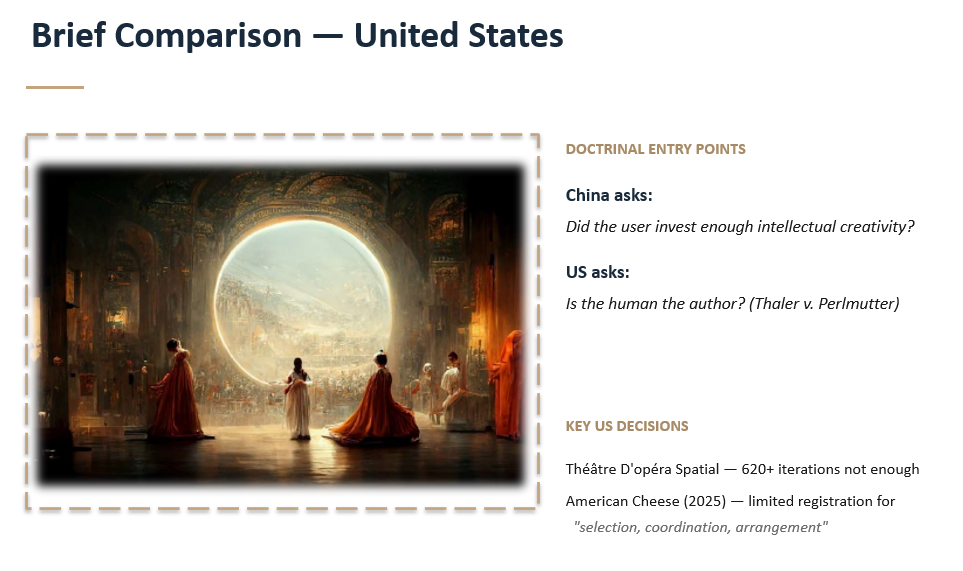
Concluding with a comparative analysis of the Chinese and U.S. approaches, Mr. Zhao observed that Chinese judicial practice is converging on a "dual-track standard": AI-generated content may receive copyright protection only where the user can demonstrate both (i) substantive creative control over the final expression and (ii) contemporaneous evidentiary support of the creation process. Neither condition alone is sufficient.
Roundtable — How to Handle IP Infringement in Overseas Investment in the Age of AI?
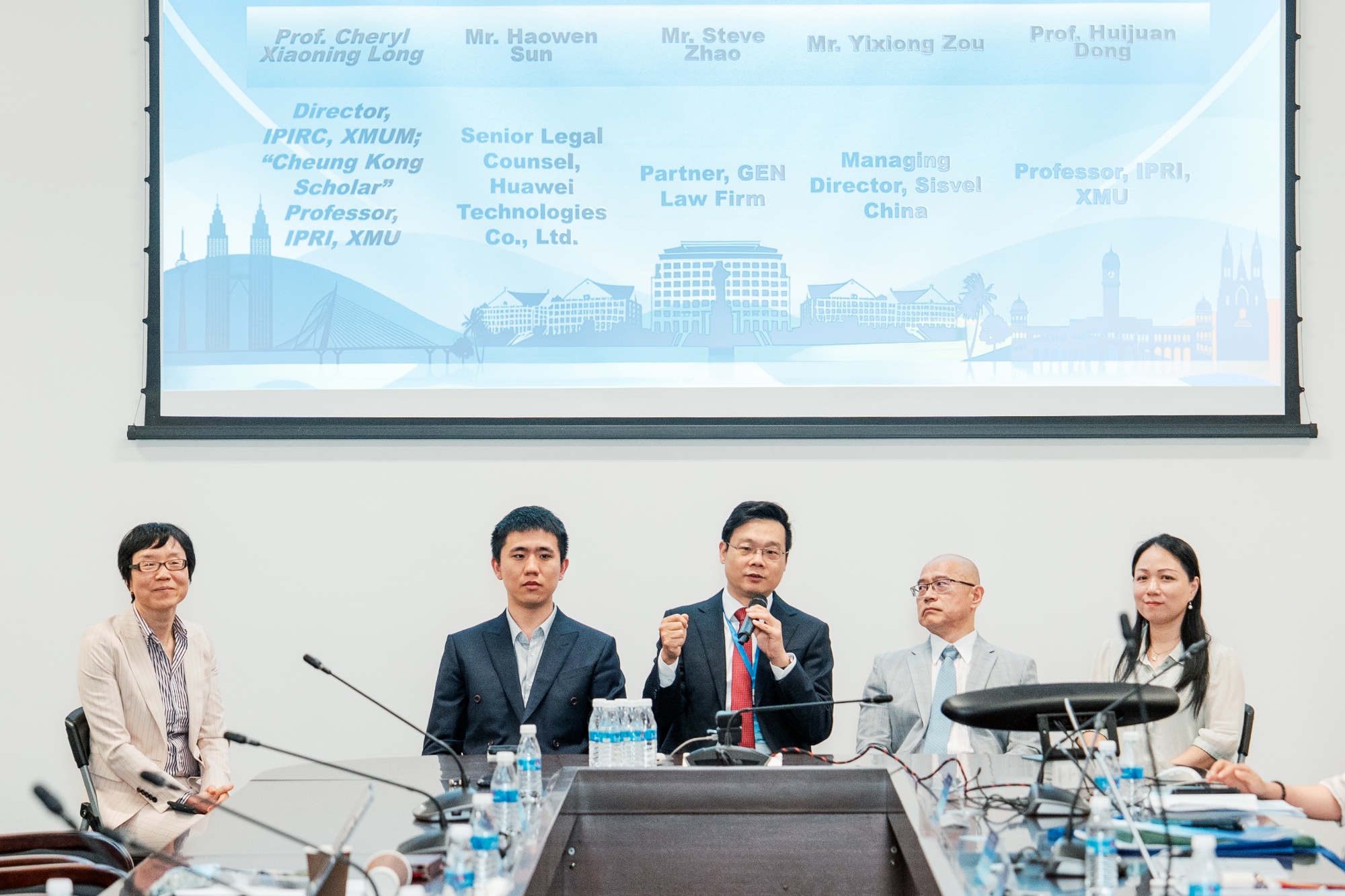
In the roundtable session that followed, moderated by Professor Long Xiaoning, Mr. Zhao joined Mr. Sun Haowen, Senior Legal Counsel, Huawei Asia-Pacific IP Department; Mr. Zou Yixiong, Managing Director, Sisvel China; and Professor Dong Huijuan of the Xiamen University IP Research Institute for an in-depth discussion on managing IP infringement risks in outbound investment in the AI era.
IPIRC Honors and Appointment
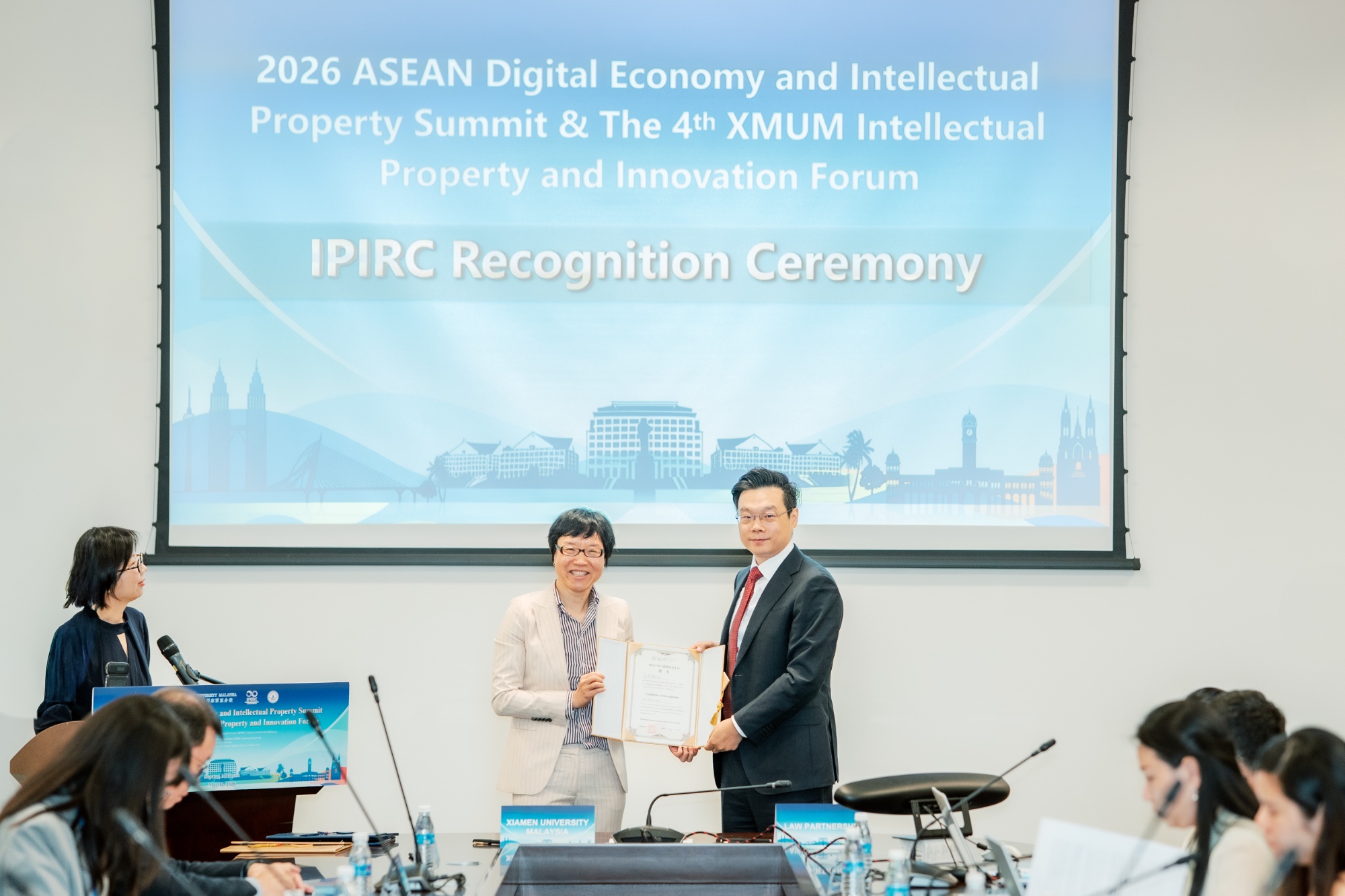
During the IPIRC Honors Ceremony, certificates were presented to individuals and institutions that have made significant contributions to the development of the regional intellectual property ecosystem.
Steve Zhao was appointed External Advisor to the Intellectual Property and Innovation Research Centre (IPIRC) of Xiamen University Malaysia — a recognition of his professional expertise and extensive practical experience in the field of intellectual property. In this capacity, Mr. Zhao will continue to contribute to frontier IP research and to advance cross-border academic exchange and practical collaboration through the IPIRC platform.
Click the link below to access Mr. Zhao's presentation slides:
https://drive.google.com/file/d/12EGW5YgewC65V2TZSsHNPRhWqEJDY8zu/view?usp=sharing