











GEN Law is pleased to share that Steve Zhao, Partner, was invited to speak at the 10th China Internet Copyright Protection & Development Conference, held in Shenzhen on 22 May 2026. Hosted by the Copyright Administration Department of the Publicity Department of the CPC Central Committee, the conference convened some 600 delegates from government, leading universities, research institutions, industry associations, and major enterprises under the theme "Improving Copyright Protection for Emerging Fields, Strengthening New Drivers of New Quality Productive Forces."

At the sub-forum on "Book Copyright Protection and High-Quality Training-Corpus Development in the AI Era," Mr. Zhao delivered a talk titled "The 'AI Rights' of Book Publishing." He shared the panel with distinguished scholars and practitioners, including Professor Cong Lixian, Dean of the Shanghai International College of Intellectual Property at Tongji University; Professor Jiang Bo of the KoGuan School of Law, Shanghai Jiao Tong University; and Mr. Zhu Kaixin, Director of the Legal Research Center at Tencent Research Institute.
On the contested question of whether copyrighted works used to train large language models warrant compensation, Mr. Zhao argued against a binary answer. The choice is not "license everything" versus "fair use across the board" — it is a dial, not a switch.
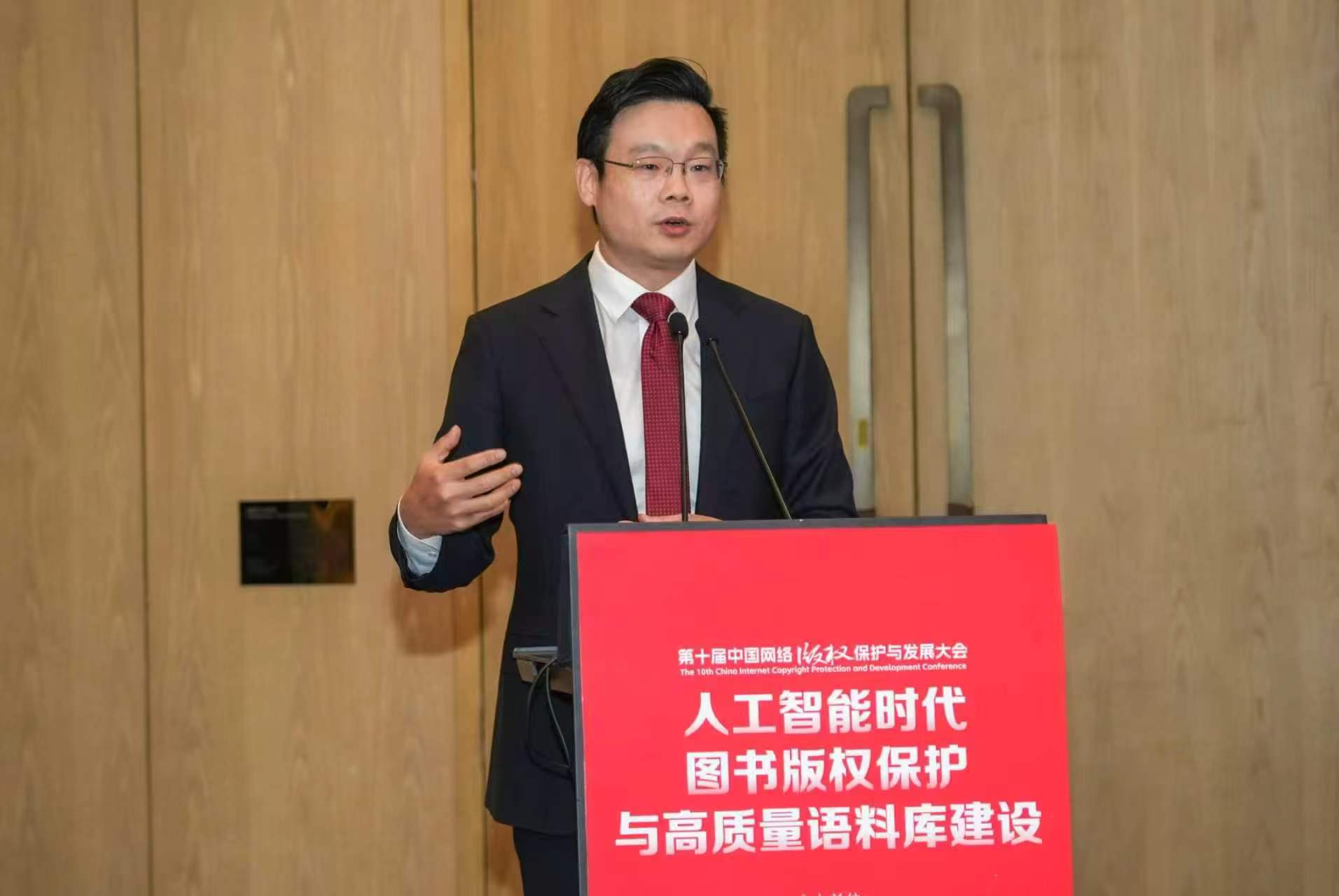
He proposed a second axis beyond transformative use: the "dual thickness" of a work — its expressive thickness (originality) and its informational thickness (accuracy, structure, density, and scarcity). Plotting works across a thickness-by-transformation matrix, he contended that thick copyright meeting weak transformation should be found infringing and should require prior licensing — anchoring the point in recent China–U.S. jurisprudence, including Thomson Reuters v. Ross Intelligence, Bartz v. Anthropic and NYT v. OpenAI. He closed with practical guidance for publishers: assert litigation rights by separating the act of copying from the act of training, embed AI clauses in publishing contracts, and pool high-value catalogues into licensable datasets.