










Author: Anagata Law Firm
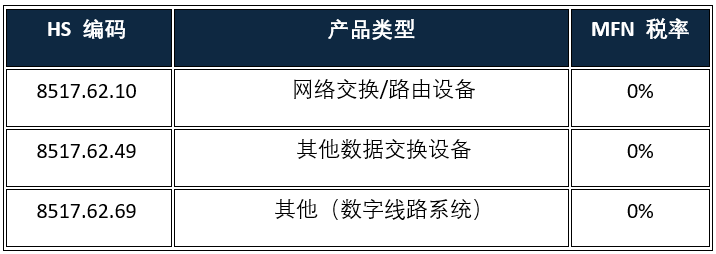
Indonesia has issued Ministry of Finance Regulation No. 62 of 2025 on the second amendment to PMK 26/PMK.010/2022 on the Stipulation of the Goods Classification System and the Imposition of Import Duty Tariffs on Imported Goods (“MOF Regulation 62/2025”). The MOF Regulation 62/2025 came into force on 15 September 2025. A principal amendment introduced under MOF Regulation 62/2025 is the adjustment of import duty treatment for certain Information and Communications Technology (“ICT”) products to reduce classification disputes and support industry growth. Specifically, products under HS subheadings 8517.62.10, 8517.62.49, and 8517.62.69 are now subject to 0% (zero) import duty. These include certain network switching/routing equipment and optical modules that have frequently been the source of divergent tariff determinations.
As part of the July 2025 U.S.– Indonesia Reciprocal Trade Agreement, the Indonesian government committed to eliminating approximately 99% of tariff barriers on U.S. goods, effectively reducing duties to 0% for most HS lines. This move was intended to strengthen bilateral trade and address longstanding market access issues, particularly for U.S. industrial, tech companies, agricultural, and health-related products.
Key Takeaways
1. Tariff certainty at 0% MFN
Import duty is zero for goods that genuinely fall within HS 8517.62.10 / .49 / .69, eliminating exposure to the previously seen 10% duty on some 8517.62 lines. Immediate effects: lower landed cost and more competitive pricing. This generally covers network switching/routing equipment and optical transceiver modules (e.g., SFP), which have been frequent sources of tariff disputes.
2. Fewer classification disputes
Network gear has often been “pulled” into neighbouring subheadings within 8517.62 or 8517.69. Clear 0% treatment on the relevant subheadings reduces the likelihood of reassessment—provided your technical documentation substantiates the chosen subheading.
3. Mitigation: Wrong HS due to thin technical evidence
Prepare detailed datasheets, port maps, routing/switching, firmware/feature lists, and label photos. Ensure invoice/packing list descriptions include BTKI-aligned keywords (e.g., switching/routing apparatus for digital line systems).
4. List of HS codes of the Notable ICT Products
Action to be taken by the Importers
Verify HS mapping: across your ICT SKUs → flag those in 8517.62.10 / .49 / .69.
Accurate HS classification and permit compliance remain essential to fully capture the 0% benefit. When in doubt, escalate for a formal opinion your customs expert.
Audit HS Code Classification: Conduct periodic HS audits to minimize exposure from misclassification and maintain audit readiness.
Compile a classification file: datasheets, photos, catalogues, feature lists, HS mapping.
Record-keeping: archive classification rationale and correspondence for audit readiness.
“With this regulation now in force, Indonesia materially reduces HS classification disputes and delivers a long-awaited policy shift, aligning the tariff treatment of covered ICT products with its WTO Information Technology Agreement commitment to apply a zero MFN rate.”
- Rinaldi Raymond.
The article reflects only the author’s views and should not be construed as the official legal opinion or advice of GEN Law Firm.If you are interested in the topics discussed in this article or would like to further communicate, please feel free to contact Attorney Jessica Lei.